
In today’s digital landscape, businesses face an ever-growing array of cybersecurity threats.
To combat these risks, two critical components form the backbone of a modern defense strategy:
SIEM (Security Information and Event Management) and the SOC (Security Operations Center).
Together, they act as a unified force, providing powerful security management to protect your critical assets.
To combat these risks, two critical components form the backbone of a modern defense strategy:
SIEM (Security Information and Event Management) and the SOC (Security Operations Center).
Together, they act as a unified force, providing powerful security management to protect your critical assets.
This guide delves into what SIEM and SOC are, how they function, and how they synergize to create a resilient security posture for your business.
Understanding SIEM: Achieving Total Security “Visibility”
SIEM (Security Information and Event Management) is a security solution that centralizes log data from various sources across your IT environment (like firewalls, servers, and EDR tools).
It integrates event alerts, performs correlation analysis, generates reports, and can even automate responses, empowering your team to establish comprehensive visibility and resolve issues faster.
Key Capabilities of a SIEM:
Security Event Monitoring:
Collects, aggregates, and analyzes logs, alerts, and events from multiple resources. It uses pre-defined rules to identify and alert on potential security threats.
Threat Detection:
Integrates with Threat Intelligence to identify known and unknown threats like malware, network attacks, and insider threats using correlation, behavioral, and anomaly analysis.
Incident Management:
Provides comprehensive event tracking and management. It stores all event data and offers querying, reporting, investigation, and forensic capabilities to ensure incidents are handled properly.
Popular SIEM Solutions:
Microsoft Sentinel, Fortinet FortiSIEM, Splunk Enterprise Security, IBM QRadar.
It integrates event alerts, performs correlation analysis, generates reports, and can even automate responses, empowering your team to establish comprehensive visibility and resolve issues faster.
Key Capabilities of a SIEM:
Security Event Monitoring:
Collects, aggregates, and analyzes logs, alerts, and events from multiple resources. It uses pre-defined rules to identify and alert on potential security threats.
Threat Detection:
Integrates with Threat Intelligence to identify known and unknown threats like malware, network attacks, and insider threats using correlation, behavioral, and anomaly analysis.
Incident Management:
Provides comprehensive event tracking and management. It stores all event data and offers querying, reporting, investigation, and forensic capabilities to ensure incidents are handled properly.
Popular SIEM Solutions:
Microsoft Sentinel, Fortinet FortiSIEM, Splunk Enterprise Security, IBM QRadar.
What about SOAR?
SOAR (Security Orchestration, Automation, and Response) is an advanced platform that builds on SIEM.
It focuses on Orchestration (streamlining workflows), Automation (executing repetitive tasks), and Response (taking action) to enable faster and more efficient incident resolution.
It focuses on Orchestration (streamlining workflows), Automation (executing repetitive tasks), and Response (taking action) to enable faster and more efficient incident resolution.
Understanding the SOC: Your 24/7 Threat Response “Tower”
A SOC (Security Operations Center) is the dedicated team—whether in-house or outsourced — that operates out of a “security war room.”
This team is responsible for the continuous, 24/7 monitoring, detection, and response to cybersecurity threats.
This team is responsible for the continuous, 24/7 monitoring, detection, and response to cybersecurity threats.
Core Functions of a SOC Team:
• Proactive Monitoring & Identification: Continuously monitors networks, systems, and applications using tools like SIEM, IDS/IPS, and EDR to detect malicious activity.
• Incident Response & Management: Investigates identified threats, analyzes their impact, and takes countermeasures to contain and eradicate them.
• Reporting & Compliance: Generates reports on security events, trends, and response actions to support risk management and meet compliance requirements (like GDPR, PCI DSS, HIPAA).
The Powerful Synergy: How SIEM and SOC Work Together
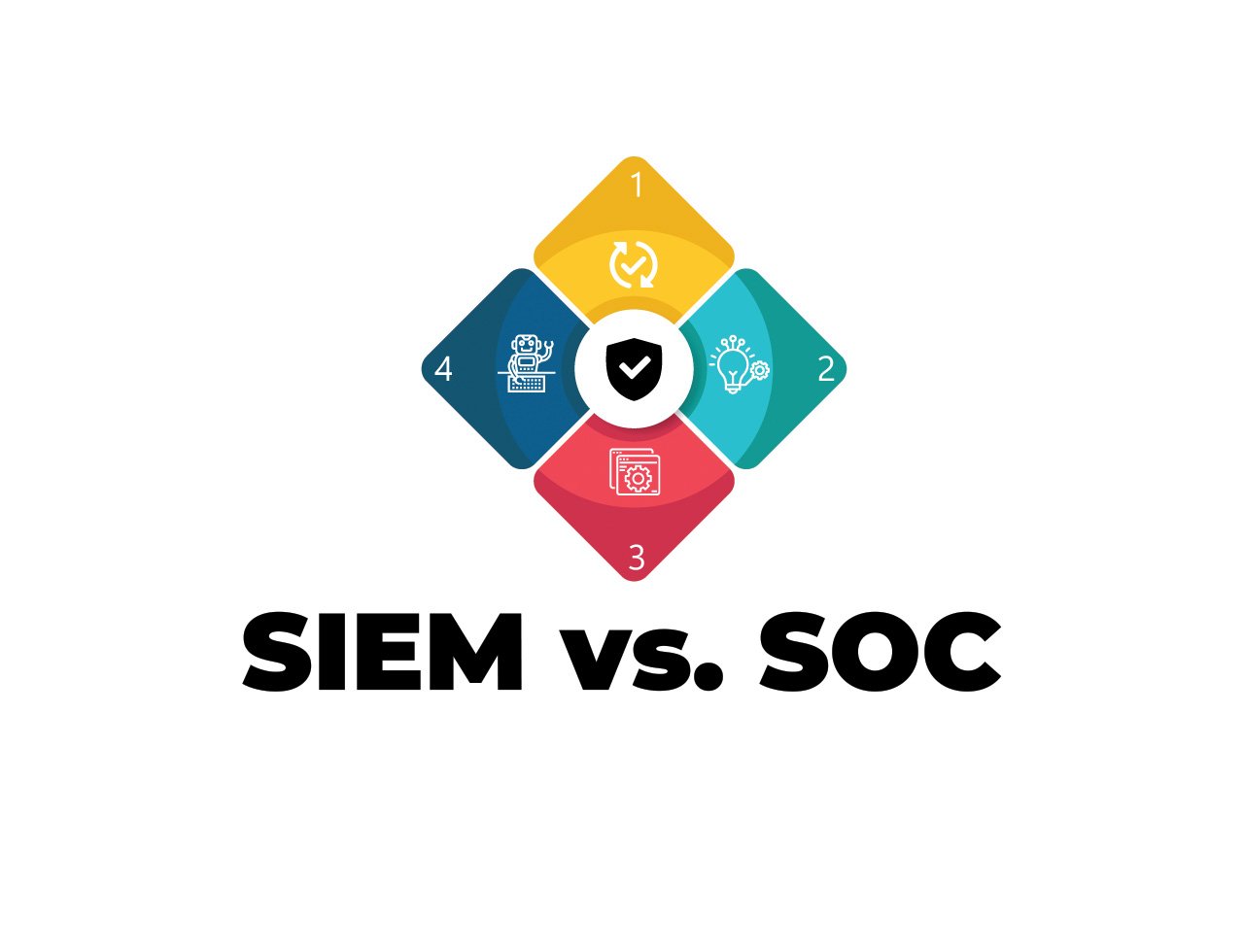
Think of it this way: The SIEM is the “technology,” and the SOC is the “people and process.”
The SIEM tool provides the SOC team with the critical, centralized data and alerts they need.
The SOC team, in turn, uses the SIEM as their primary console to monitor, investigate, and respond to threats quickly and effectively.
This synergy is essential for blocking attackers, patching vulnerabilities, and maintaining business security.
The SIEM tool provides the SOC team with the critical, centralized data and alerts they need.
The SOC team, in turn, uses the SIEM as their primary console to monitor, investigate, and respond to threats quickly and effectively.
This synergy is essential for blocking attackers, patching vulnerabilities, and maintaining business security.
Common Challenges When Implementing SIEM & SOC
Complex Deployment:
Integrating diverse systems and configuring the SIEM can be technically challenging.
Alert Fatigue:
Without proper tuning and processes, the volume of alerts can overwhelm teams, leading to missed threats.
Cybersecurity Skills Shortage:
Finding and retaining skilled analysts is difficult and expensive.
Budget & Cost Optimization:
Justifying the investment in technology, tools, and talent requires careful planning.
Meeting Compliance:
Ensuring the operation adheres to industry regulations and audit standards adds another layer of complexity.
Is Your Business Ready for SIEM and SOC?
Not every organization needs a full-scale SOC on day one.
Here’s who should consider it:
1. You Have Multiple Security Tools:
If you already have firewalls, EDR, and cloud services generating logs, a SIEM is the logical next step to centralize and make sense of that data.
2. High Network Traffic & Cloud Usage:
E-commerce, SaaS, and gaming companies that face complex threats and cannot afford downtime benefit immensely from 24/7 monitoring.
3. Handling Sensitive Data & Strict Compliance:
Businesses in finance, healthcare, or government that need full visibility to protect sensitive information and meet regulatory mandates are prime candidates.
Here’s who should consider it:
1. You Have Multiple Security Tools:
If you already have firewalls, EDR, and cloud services generating logs, a SIEM is the logical next step to centralize and make sense of that data.
2. High Network Traffic & Cloud Usage:
E-commerce, SaaS, and gaming companies that face complex threats and cannot afford downtime benefit immensely from 24/7 monitoring.
3. Handling Sensitive Data & Strict Compliance:
Businesses in finance, healthcare, or government that need full visibility to protect sensitive information and meet regulatory mandates are prime candidates.
Unified Defense:
Your Integrated Security Command Center with GOIP
Why choose between the “sword” and the “warrior” when you can have both, perfectly unified?
GOIP’s integrated SIEM x SOC service provides a complete, subscription-based security solution.
If you lack the in-house expertise, tools, or 24/7 coverage, we deliver the people, processes, and technology you need.
GOIP’s integrated SIEM x SOC service provides a complete, subscription-based security solution.
If you lack the in-house expertise, tools, or 24/7 coverage, we deliver the people, processes, and technology you need.
Stop reacting to threats and start preventing them.
[Contact GOIP today] to discover how our managed SIEM and SOC services can build your cybersecurity command center.