



Webscale cloud solutions
Webscale cloud solutions powering enterprise and AI-driven data center networking. Scalable, high-capacity DWDM solutions leveraging C+L band transmission for long-haul and subsea networks.
Increased Capacity
Support for up to 192 wavelengths, with capacities reaching 400Gbit/s per wavelength and higher.
Reduced Power/Space
Improved power utilization, with some solutions reducing power consumption by ~35%.
Operational Efficiency
Faster, “cookie-cutter” deployment models with built-in intelligence.
Enterprise Webscale, Cloud-Powered. Feasible. Seamless.
Operate at webscale with mission-critical network control and security
A greater number of network devices that require configuration and management is driving a change in how data center networks are designed in order to provide greater bandwidth within and between data centers.
The predominant approach is to use ClOs principles and leaf-spine fabrics which are more scalable, comprising a group of switches managed as a logical unit. Multiple fabrics are replicated within data centers and across data centers, zones and regions.
But data center operators – including webscale companies, service providers and large enterprises, now need data center fabrics that are even more scalable without being too complex or costly to build and operate.
Leverage webscale approaches in your enterprise environment.
Use case describes how our cloud approach makes webscale not only viable but also feasible without requiring a forklift
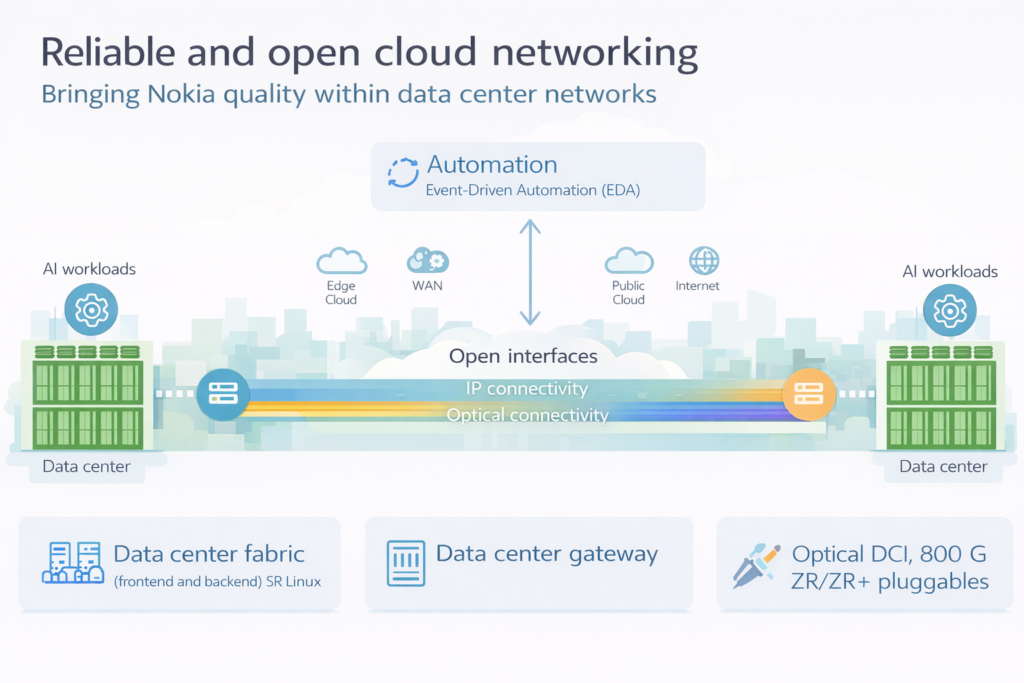
Today’s cloud building solution challenges
Although data center networks and operations have become more open and scalable, today’s solutions are not always as open as cloud builders and data center operators want.
Your key challenge is to balance the need to constantly scale data center fabrics against the increasing costs of designing, building and operating them.
The new Data Center Fabric solution is the answer Fabric
Welcome to network operations on your terms. Rapidly design and deploy, easily adapt and integrate, and confidently operate and automate data center network fabrics at scale.
Your key challenge is to balance the need to constantly scale data center fabrics against the increasing costs of designing, building and operating them.
Use case
Operate at high scale/webscale, get mission-critical network control and security, and get ahead of your competition
Do you have a mandate to lead worldwide in terms of functionality that you provide over the web? Are you asked to deliver scalability more akin to the levels attained by consumer web providers more so than that of other enterprises? Are you struggling with delivering so-called webscale within the constraints of your legacy environment?
Let show you how to leverage webscale approaches in your enterprise environment.
This Faster, “cookie-cutter” deployment models with built-in intelligence. use case describes how our cloud approach makes webscale viable and provides a framework for market-leading approaches.
How our approach changes the game
This innovative approach provides a webscale cloud with scalability up to the level of the largest webservice providers.
Major capabilities include:
Major capabilities include:
Challenges
Leading-edge functionality
Most webscale enterprises seek to capitalize on an entirely new market where functionality and time to market are critical, or to disrupt an existing market, which makes leading-edge functionality critical. In both instances, these enterprises strive for functionality not found in legacy products.
As a result, they can’t rely on their in-house resources so they typically leverage open source projects. And, because they need to unify a variety of code bases, they usually focus on industry-standard APIs, such as REST.
As a result of their business model plus their need to leverage both in-house and open source projects, their applications are typically designed as a distributed architecture. Since the focus is on software, these enterprises want to minimize reliance on vendor-specific hardware and maximize their ability to control the entire stack using software.
As a result, they can’t rely on their in-house resources so they typically leverage open source projects. And, because they need to unify a variety of code bases, they usually focus on industry-standard APIs, such as REST.
As a result of their business model plus their need to leverage both in-house and open source projects, their applications are typically designed as a distributed architecture. Since the focus is on software, these enterprises want to minimize reliance on vendor-specific hardware and maximize their ability to control the entire stack using software.
Online delivery
Webscale enterprises typically differ from other large enterprises in that their revenue comes largely, if not all, from online business. So, if web properties are down, the revenue impact is catastrophic. Further, they typically have heightened compliance needs from operating globally as well as often providing regulated services such as financial transactions, gaming, and even betting.
Further, legacy architectures rely on high-end, reliable hardware configured in high-availability pairs so that a single failure will not take down the system. In contrast, webscale configurations rely on lots of inexpensive hardware configured in parallel so that even multiple hardware failures do not impact availability.
As a result of this approach and scalability, logging demands for capacity management, problem determination, and compliance often exceed the capability of legacy tools, including databases. That’s why webscale companies typically appreciate big data approaches for handling volumes of data and for automating compliance tracking.
Further, legacy architectures rely on high-end, reliable hardware configured in high-availability pairs so that a single failure will not take down the system. In contrast, webscale configurations rely on lots of inexpensive hardware configured in parallel so that even multiple hardware failures do not impact availability.
As a result of this approach and scalability, logging demands for capacity management, problem determination, and compliance often exceed the capability of legacy tools, including databases. That’s why webscale companies typically appreciate big data approaches for handling volumes of data and for automating compliance tracking.
Staggering scale
Saving perhaps the most profound difference for last, webscale companies handle staggering volumes of business whether that is measured in transactions, web pages, or data most typically using a web-based front-end.
Webscale companies also have to accommodate
huge variability in demand across applications, geographies, and events.
Webscale companies also have to accommodate
huge variability in demand across applications, geographies, and events.
Ready to Elevate Your Global Infrastructure?
Contact Our Enterprise Engineers for a Free Consultation
Maximize your network performance, mitigate cybersecurity risks, and scale your operations with GOIP’s tailored B2B solutions. Schedule a comprehensive architecture review with our expert engineers today.