


When choosing a network provider, businesses often focus on speed and cost.
However, a critical metric many neglect is latency.
As companies rely more on cloud applications and real-time tools, understanding and managing latency becomes essential for performance.
However, a critical metric many neglect is latency.
As companies rely more on cloud applications and real-time tools, understanding and managing latency becomes essential for performance.
What is Network Latency?
Network Latency is the time delay it takes for a data packet to travel from its source to its destination across a network.
It’s often measured in milliseconds (ms).
Despite advances in technology, latency is constrained by the laws of physics.
Even data traveling at the speed of light through fiber-optic cables experiences delay, especially over long distances.
You can’t fix this simply by adding more bandwidth.
The Bandwidth vs. Latency Analogy:
Imagine a delivery truck with a top speed of 60 mph. If the destination is 60 miles away, it will take at least one hour to arrive — whether it’s driving on a two-lane road or a 10-lane highway.
Here, bandwidth is the number of lanes, but latency is the travel time. More lanes don’t make the truck faster.
Other factors that increase latency include:
Here, bandwidth is the number of lanes, but latency is the travel time. More lanes don’t make the truck faster.
Other factors that increase latency include:
Network Congestion
Too much data traffic on a route.
Network Complexity
Multiple hand-offs and network devices.
File-Transfer Method
The protocol used to send data.
How Does Latency Impact Applications?
Depending on the task, latency can be a minor annoyance or a major operational roadblock.
Latency-Sensitive Applications (Struggle with High Latency)
VoIP & Video Conferencing:
High latency causes awkward pauses, “talk-over” moments, and frozen screens, leading to “Zoom fatigue” and inefficient communication.
Remote Desktop / Virtual Desktop:
Every mouse click and screen refresh feels sluggish, hampering productivity for remote workers and IT support.
Windows File Transfers:
Latency can drastically slow down file copy operations, making them feel like a step back in time.
Streaming Media:
Can cause buffering and audio-video sync issues.
Niche & Emerging Technologies:
• IoT Devices (e.g., autonomous cars, drones)
• High-Frequency Stock Trading
• Online Gaming
• High-Resolution Image Transfers (e.g., Medical MRI/CT Scans)
Applications Less Impacted by Latency
These are typically asynchronous or not real-time:
• Customer Relationship Management (CRM) Platforms
• Productivity Suites (Office 365, Google Workspace)
• E-commerce Platforms
• Billing and Audit Tools
• Customer Relationship Management (CRM) Platforms
• Productivity Suites (Office 365, Google Workspace)
• E-commerce Platforms
• Billing and Audit Tools
Latency and File Transfer Methods: TCP vs. UDP
The protocol you use significantly affects latency. Here’s a comparison of the two most common methods:
| Protocol | How It Works | Impact on Latency |
| UDP (User Datagram Protocol) | Sends data packets in a continuous stream without checking for delivery. | Lower Latency: Faster, but unreliable. Ideal for live video/audio where losing a packet is better than waiting for it. |
| TCP (Transmission Control Protocol) | Sends packets in order and requires an acknowledgment for each one. Resends lost packets. | Higher Latency: More reliable, but the “handshake” for each packet increases delay. Best for file downloads and web browsing. |
If a critical application is sluggish, investigating its transfer protocol is a great first step in troubleshooting.
3 Strategies to Reduce Network Latency
Proactive network planning can mitigate many latency challenges.
Host applications and files on servers that are geographically close to their primary users.
For a distributed workforce, use a cloud provider with multiple data centers or a Content Delivery Network (CDN) to serve data from a local point.
For a distributed workforce, use a cloud provider with multiple data centers or a Content Delivery Network (CDN) to serve data from a local point.
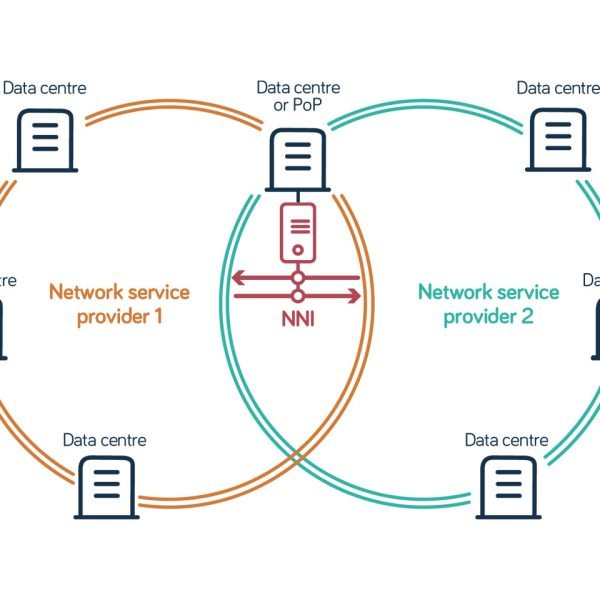
Every additional network device, hand-off, or protocol conversion adds milliseconds of delay.
Common Culprit: VPNs. Each VPN hop can add ~100ms of latency. Avoid layering multiple VPNs where possible.
Common Culprit: VPNs. Each VPN hop can add ~100ms of latency. Avoid layering multiple VPNs where possible.
Don’t assume buying more bandwidth is the solution. Often, simpler, more cost-effective changes — like fixing server location or simplifying network paths—deliver a greater performance boost.
Is latency impacting your business applications?
Optimizing your network for performance is crucial.
Contact us today for a consultation to ensure your connectivity supports your business goals.
Contact us today for a consultation to ensure your connectivity supports your business goals.